



WhatsApp Business API
What Is WhatsApp Business API and Why Does It Matter?
WhatsApp Business API has been around for years. The technology is no longer the difficult part. The real opportunity is what businesses build around it.
WhatsApp has become one of the most important communication channels between businesses and customers.
But there is a major difference between using the regular WhatsApp Business App and using the WhatsApp Business Platform / API.
The app is designed for people to manage conversations manually. The API is designed to connect WhatsApp with software, automation, CRM systems, websites, AI and business processes.
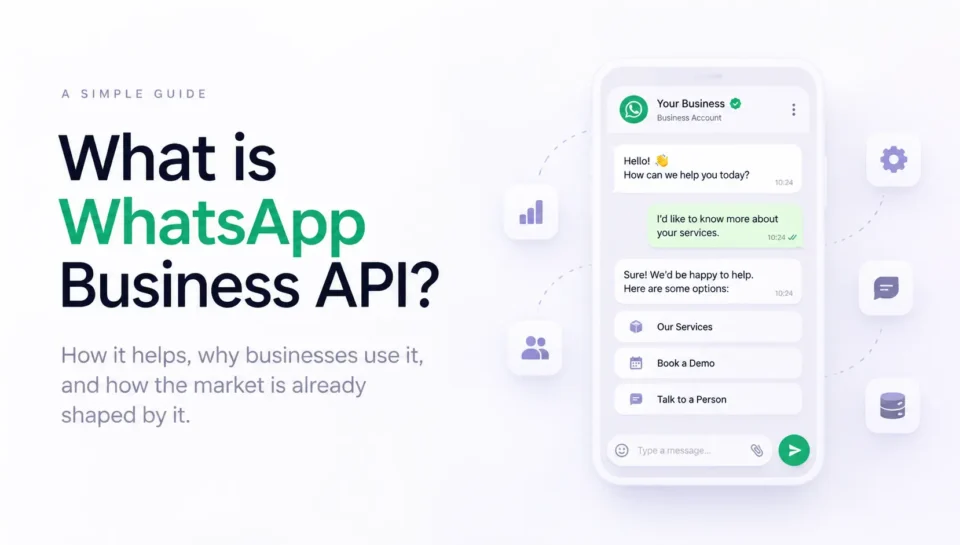
What is WhatsApp Business API?
WhatsApp Business API allows a business to connect WhatsApp with its own systems and applications.
Instead of someone manually handling every message, WhatsApp can become part of an automated business workflow.
Meta introduced its cloud-based WhatsApp Business Platform in 2022, making it much easier for businesses and developers to connect their systems directly to WhatsApp. :contentReference[oaicite:1]{index=1}
What can a business actually do with it?
The API becomes useful when WhatsApp is connected to the rest of the business.
Lead Management
Capture leads from websites, advertisements or forms and automatically start a WhatsApp conversation.
Automated Follow-ups
Send reminders, follow-ups, updates and notifications without requiring someone to manually send every message.
CRM Integration
Connect WhatsApp conversations with customer records, sales pipelines, tickets and internal workflows.
Order Updates
Send order confirmations, shipping updates, delivery information and other transactional notifications.
AI Conversations
Connect AI to WhatsApp so customers can ask questions, receive information and get assistance automatically.
Internal Automation
Trigger actions in other systems when something happens inside a WhatsApp conversation.
So, is WhatsApp API still new?
No.
This is an important point for businesses considering WhatsApp automation today.
WhatsApp Business API is already a mature technology. Thousands of businesses, agencies and technology providers have been building solutions around it for years.
In India especially, adoption has become significant. Meta stated in 2025 that WhatsApp Cloud API was powering around 70,000 Indian businesses every month, with adoption continuing to grow. :contentReference[oaicite:2]{index=2}
Meta has also continued expanding the platform with AI capabilities, business calling, marketing tools and other business communication features. :contentReference[oaicite:3]{index=3}
The API market is crowded
The basic idea of selling “WhatsApp API integration” is no longer particularly unique.
There are already many providers offering WhatsApp onboarding, message templates, dashboards, chat inboxes and basic automation.
That means businesses should ask a better question.
WhatsApp is becoming a business layer
The interesting part is no longer the API itself. It is the ecosystem around it.
A customer might discover a business through Instagram or an advertisement, start a conversation on WhatsApp, become a lead in the CRM, receive automated follow-ups, speak with an AI assistant and eventually complete a purchase.
WhatsApp is simply one part of that larger system.
Where the real opportunity is now
The next stage of WhatsApp development is not about sending more messages.
It is about creating better business systems.
- WhatsApp connected to CRM
- WhatsApp connected to websites
- WhatsApp connected to ecommerce
- WhatsApp connected to lead generation
- WhatsApp connected to AI
- WhatsApp connected to customer support
- WhatsApp connected to internal workflows
- WhatsApp connected to sales and follow-ups
And this is where businesses should think differently
A business does not necessarily need another WhatsApp inbox.
It needs a system that understands what happens after a customer sends a message.
Who gets the lead?
Where is the customer stored?
What happens if nobody responds?
When should the customer be followed up?
Can AI answer the first question?
Can the CRM create a ticket?
Can the website trigger the conversation?
Those questions are much more valuable than simply asking whether WhatsApp can be connected.
WhatsApp API is no longer the product. What you build with it is.
The technology has matured. The market is crowded. But businesses are still looking for better ways to manage leads, sales, support and customer communication.
That is where custom WhatsApp automation, CRM integration and AI become much more interesting.